inquiry
Leave Your Message
0%

Picking the right Copper Pcb Sheet supplier isn't just a purchasing detail—it can affect how reliable your board is, what kind of yield you get, and what it ends up costing over time. Different manufacturers are built for different jobs, whether you're making a one-off prototype or ramping up automotive production. And even when materials look similar on paper, things like copper weight, resin content, dielectric thickness, and surface treatment can shift a lot.

This guide looks at some of the major manufacturers and suppliers, including Rogers Corporation, Isola Group, Panasonic Industry, Kingboard Laminates, Shengyi Technology, and Nan Ya Plastics. They all offer well-known laminate portfolios for rigid, high-frequency, thermal, and multilayer applications. Their technical docs are worth digging into if you need to compare Dk, Df, peel strength, thermal stress, and processing limits. Certification matters too, so keep an eye out for clear IPC standards references, UL recognition, RoHS, and REACH compliance.

The small details really do matter. A 1-ounce copper layer won't behave the same as a 3-ounce layer during etching and plating. A material that's great for signal integrity might struggle in a high-heat power circuit. Supplier support is part of the picture too. Ask for lot traceability, test reports, sample panels, and lead times that aren't just wishful thinking. Don't trust a shiny catalog by itself.

No supplier is perfect, obviously. Even the big names can hit capacity limits, regional delays, or communication that gets a little inconsistent. Pricing can hide differences in yield and processing effort, too. So a careful buyer should compare the full technical data, not just the quoted sheet price. This article covers practical selection factors and leading industry names, while keeping in mind that the best choice really comes down to design frequency, thermal load, production volume, and the reliability you need.
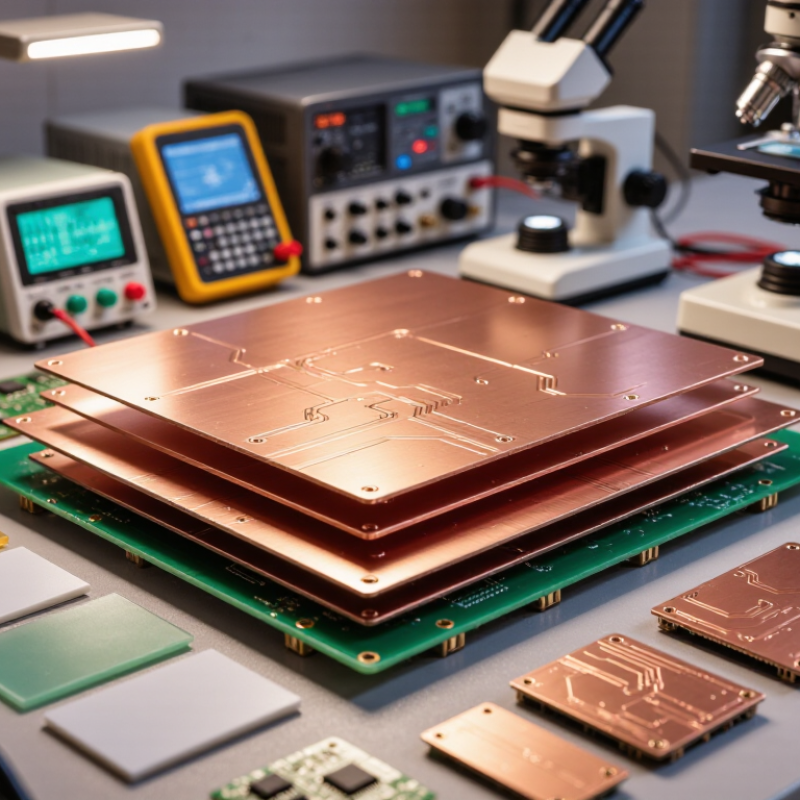
Top Copper PCB Sheet Manufacturers and Suppliers?

Copper PCB Sheets: Definition, Structure, and Core Functions

A Copper PCB Sheet is a laminated material used to build rigid printed circuit boards. Its structure usually contains copper foil, a resin-rich dielectric layer, and reinforced glass fabric. The copper carries electrical signals, while the dielectric controls insulation and spacing. In a typical Copper Clad Pcb Sheet, copper is bonded to one or both sides of the insulating core.

Copper thickness is commonly measured in ounces per square foot. One-ounce copper is approximately 35 micrometers thick. Thicker copper supports higher current but may reduce etching precision. NIST data places copper conductivity near 5.96 × 10⁷ S/m at 20°C, explaining its strong role in power and signal distribution. IPC-4101 material specifications also address dielectric performance, thermal stability, and laminate quality. Small changes matter.

The structure must withstand heat, pressure, moisture, and repeated soldering cycles. IPC’s 2024 technology roadmap highlights finer lines, higher layer counts, and greater thermal demands in advanced electronics. Industry market reports also forecast steady growth for copper-clad laminate demand through 2030, driven by automotive, communication, and industrial electronics. Yet market growth does not guarantee uniform quality. A sheet may meet its thickness claim but still show resin voids, uneven copper adhesion, or excessive warpage. Engineers should verify datasheets with cross-section inspection, peel-strength testing, and thermal-stress results. The simple definition is helpful, but incomplete.

Key Materials and Specifications of Copper PCB Sheets

A Pcb Sheet is built around copper foil, dielectric resin, and reinforcing fabric. Copper thickness commonly ranges from 18 to 105 micrometers. Thicker foil carries more current, but it complicates etching and fine-line routing. IPC-2221 design guidance links conductor width and thickness with allowable current and temperature rise. That relationship matters near power connectors.

FR-4 remains widely specified because it balances cost, stiffness, and process stability. Key values include glass-transition temperature, dielectric constant, dissipation factor, and z-axis expansion. High-reliability laminates often use a Tg above 150°C, while low-loss materials target lower Dk and Df values. IPC-TM-650 test methods help verify these properties, though published figures can vary by resin content and test frequency.

Copper purity also affects consistency. The U.S. Geological Survey reported approximately 22 million metric tons of global mined copper production in 2023, showing the scale behind this supply chain. However, mine output does not equal electronic-grade foil availability. Foil suppliers must control surface roughness, tensile strength, and elongation. Rougher copper can improve adhesion, yet it may increase signal loss at high frequencies. Data can mislead. In practice, engineers should compare test coupons, laminate certificates, and actual impedance results, not only catalog values. A small material mismatch can become visible as warped panels, weak plating, or unstable high-speed signals.

Key Materials and Specifications of Copper PCB Sheets

This chart compares common nominal copper thicknesses used in PCB sheets with their equivalent copper weight and ideal bulk-copper sheet resistance at 20°C. Values are based on a copper density of 8.96 g/cm³ and resistivity of 1.68 × 10⁻⁸ Ω·m.

Thicker copper layers generally support higher current capacity and lower electrical resistance. Actual PCB performance also depends on trace width, temperature rise, plating, etching tolerance, and laminate construction.

Leading Copper PCB Sheet Manufacturers and Suppliers

Leading Copper PCB Sheet Manufacturers and Suppliers

Leading copper PCB sheet manufacturers and suppliers compete on more than price. Their value appears in copper thickness control, resin consistency, and dependable delivery. A capable supplier provides clear datasheets, batch numbers, and test reports for every production lot. Those records help engineers trace problems before they reach assembly.

Material selection starts with the circuit design. A Fr4 Pcb Sheet may suit common multilayer boards, while high-frequency projects require tighter dielectric control. Copper foil should remain uniform across the panel. Even small thickness variations can affect etching, impedance, and thermal performance. Experienced manufacturers inspect surface roughness, dimensional stability, and drilling behavior. They also explain tolerances instead of hiding behind general specifications.

Factory visits and sample evaluations reveal practical differences. Check panel flatness under strong side lighting. Review cross-sections after lamination. Ask how moisture exposure is controlled during storage. I have found that packaging often receives less attention than it deserves. That is a weakness worth questioning. No supplier is flawless, and honest communication matters when defects appear. Reliable partners respond with corrective reports, replacement plans, and evidence from repeat testing. Their technical teams should discuss lead times realistically, especially for unusual copper weights or custom panel sizes. Safety documentation and responsible waste handling also reflect mature manufacturing practices.

Top Copper PCB Sheet Manufacturers and Suppliers? - Leading Copper PCB Sheet Manufacturers and Suppliers

Supplier Category Typical Product Type Common Copper Grade Typical Copper Thickness Typical Board Application Relevant Standard or Specification Key Selection Criteria
Standard rigid PCB laminate suppliers Copper-clad laminate sheets for rigid printed circuit boards Electrolytic copper foil or rolled copper foil Commonly 18, 35, and 70 µm Consumer electronics, industrial controls, and general-purpose PCBs IPC-4101 for base materials; IPC-4562 for copper foil Laminate construction, dielectric thickness, peel strength, and dimensional stability
High-frequency laminate suppliers Low-loss copper-clad sheets for controlled-impedance circuits Rolled or electrodeposited copper with controlled surface profile Often 18 or 35 µm, subject to design requirements RF equipment, antennas, radar systems, and high-speed digital circuits IPC-4103 for high-frequency and high-speed circuit materials Dk, Df, copper roughness, frequency stability, and impedance control
High-temperature laminate suppliers High-Tg and thermally stable copper-clad laminates Electrolytic copper foil, with options for higher thermal reliability Commonly 18–105 µm depending on current and design needs Automotive electronics, power modules, and industrial equipment IPC-4101 material requirements and customer-defined thermal testing Tg, Td, Z-axis expansion, thermal cycling, and soldering reliability
Heavy-copper PCB material suppliers Heavy-copper-clad sheets and current-carrying PCB substrates Thick electrolytic copper foil or copper-supported laminate structures Typically above 70 µm; final thickness is design-specific Power conversion, battery systems, motor drives, and energy equipment IPC-6012 performance requirements for rigid printed boards Current-carrying capacity, thermal dissipation, etching capability, and flatness
Metal-core PCB sheet suppliers Copper-clad or insulated-metal-substrate sheets Copper foil bonded to thermally conductive dielectric and metal backing Copper thickness selected according to electrical load LED lighting, automotive lamps, power supplies, and thermal-management boards IPC-4101 where applicable; thermal conductivity is usually customer-specified Thermal conductivity, dielectric breakdown strength, bond strength, and flatness
Flexible PCB copper foil suppliers Flexible copper-clad laminates and copper foil for flex circuits Rolled annealed copper or flexible electrodeposited copper Commonly 12, 18, or 35 µm Wearables, displays, cameras, medical devices, and compact electronics IPC-4204 for flexible metal-clad dielectric materials Flexibility, bend endurance, elongation, surface treatment, and dimensional stability
Prototype and quick-turn distributors Cut-to-size copper-clad sheets and engineering sample materials Standard electrolytic copper foil on common resin systems Frequently stocked in 18, 35, and 70 µm Prototype fabrication, laboratory development, and small production runs Material datasheet, certificate of conformity, and applicable IPC specification Stock availability, minimum order quantity, cutting tolerance, traceability, and delivery time
Custom industrial material suppliers Specially engineered copper-clad sheets for demanding environments Copper selection based on conductivity, flexibility, thermal, and mechanical requirements Specified by electrical load, fabrication process, and end-use reliability Aerospace, medical, transportation, defense, and advanced industrial systems Customer drawings, qualification plans, IPC standards, and sector-specific requirements Process qualification, lot traceability, inspection reports, change control, and long-term supply capability

Note: Copper thickness, laminate construction, electrical properties, and qualification requirements vary by material family and application. Final specifications should be confirmed against the supplier’s current datasheet and purchase specification.

Manufacturing Processes and Quality Control Standards

Copper PCB sheet quality begins with controlled material selection, not the final inspection. The USGS Mineral Commodity Summaries 2024 reported global mined copper production of about 22 million metric tons in 2023. Refining consistency still varies by source. Manufacturers should verify foil purity, thickness, tensile strength, and surface roughness before lamination.

Manufacturing usually combines copper foil, resin, and reinforcement under measured heat and pressure. Operators record temperature curves, press pressure, curing time, and cooling rates. A reliable Pcb Data Sheet should show dielectric thickness, copper weight, tolerance limits, and test methods. IPC-6012 and IPC-A-600 provide widely used acceptance guidance for rigid printed boards. Quality teams inspect resin voids, dents, oxidation, warpage, and uneven plating. Cross-section testing can reveal a weak bond hidden beneath a clean surface.

Small defects matter.

Tips: Ask suppliers for lot-level certificates, traceability records, and recent cross-section images. Compare the Pcb Data Sheet with actual incoming measurements. Use calibrated micrometers and X-ray fluorescence testing for copper thickness. ISO Survey data has repeatedly shown ISO 9001 as one of the world’s most widely adopted quality-management standards, but certification alone proves little about daily process discipline. I have seen excellent-looking sheets fail after thermal cycling. That uncomfortable result deserves investigation, not excuses. Suppliers should document corrective actions, retesting, and operator training. A missing record may be more concerning than a visible scratch.

Applications Across Electronics and Industrial Equipment

Copper PCB sheets support dense electronics and demanding industrial equipment. Their value comes from conductivity, heat spreading, and mechanical stability.

Grand View Research estimated the global printed circuit board market at over 80 billion US dollars in 2023. Its forecast also indicates continued growth through 2030, driven by vehicles, communications equipment, and consumer electronics. Copper-clad sheets are used in power modules, LED lighting, inverters, sensors, and control boards. In high-current designs, thicker copper helps reduce resistance and local heating. It does not solve every thermal problem. Poor airflow still creates hot spots.

Industrial equipment requires stronger performance than ordinary office electronics. Motor drives, battery systems, welding controls, and renewable-energy converters may face vibration, humidity, and repeated temperature changes. IPC reliability guidance highlights thermal cycling, insulation quality, and conductor spacing as critical design concerns. Supplier evaluation should therefore include copper thickness tolerance, laminate classification, peel strength, and traceable test records. The International Copper Study Group continues to report strong structural demand from electrification and power infrastructure, supporting long-term interest in copper-based circuit materials.

The best supplier is not always the cheapest. A small cost reduction can create larger field-service expenses. Engineers should compare sample results, process consistency, certification evidence, and delivery stability. Some datasheets look impressive. Production evidence matters more. Performance can also vary between batches, so incoming inspection remains necessary.

How to Evaluate and Select a Reliable Supplier

Selecting a reliable copper PCB sheet supplier requires more than comparing prices. Copper availability remains a practical concern. The International Copper Study Group projected a refined copper deficit of 194,000 metric tonnes for 2025. This pressure can affect lead times and contract stability. Ask suppliers about copper origin, inventory levels, and backup sourcing. Request recent certificates of analysis, thickness data, and lot traceability.

Evaluate technical consistency through measurable evidence. Check copper thickness tolerance, surface roughness, peel strength, thermal performance, and dimensional stability. IPC-4101 provides widely used requirements for rigid and multilayer laminate materials. A capable supplier should provide test methods, calibration records, and batch-level inspection reports. Samples must be tested under your actual etching, drilling, and lamination conditions. A polished sample can hide weak production control. That is easy to overlook.

Tips: Compare at least three qualified suppliers. Visit the production site when possible. Review nonconformity records, corrective actions, and delivery performance. Confirm minimum order quantities before approval. Do not accept vague claims such as “high quality.” Require numerical limits and signed documentation. Also, reassess the supplier annually, because copper prices, capacity, and process discipline can change. My own judgment would remain cautious: a low defect rate from ten sample sheets proves very little.

FAQS

What is a copper PCB sheet?

It is a laminated material for rigid printed circuit boards. It usually contains copper foil, resin, and reinforced glass fabric.

What does each layer do?

Copper carries electrical signals and power. The resin layer provides insulation. Glass fabric adds strength and dimensional stability.

How is copper thickness measured?

Copper thickness is commonly measured in ounces per square foot. One-ounce copper measures about 35 micrometers thick. Thicker copper carries more current but can reduce etching precision.

Why do heat and moisture resistance matter?

PCB sheets face heat, pressure, moisture, and repeated soldering. Poor stability may cause warpage, delamination, or unreliable connections. Small material changes can matter.

Which tests help verify sheet quality?

Review thickness data, peel strength, thermal-stress results, and cross-sections. Inspect resin distribution and copper adhesion. A polished sample proves little.

What information should a supplier provide?

Request datasheets, batch numbers, test reports, and lot traceability. Ask for numerical tolerances, not vague quality claims. Documentation should match the supplied material.

How can copper PCB sheet suppliers be compared?

Compare at least three qualified suppliers. Review copper thickness control, flatness, surface roughness, and delivery records. Factory visits can reveal packaging and storage weaknesses.

What should be checked before approving samples?

Test samples under real etching, drilling, and lamination conditions. Confirm minimum order quantities and realistic lead times. Ten good sheets are not enough evidence.

Conclusion

A Copper Pcb Sheet is a conductive base material used to build reliable printed circuit boards for electronic and industrial equipment. It generally consists of a copper foil bonded to an insulating substrate, with the copper layer forming conductive paths for transmitting electrical signals and power. Important specifications include copper thickness, substrate type, thermal performance, dielectric strength, dimensional stability, surface quality, and compatibility with different circuit fabrication methods. Selecting the right combination helps improve electrical efficiency, heat dissipation, mechanical strength, and long-term product reliability.

This overview also explains how leading manufacturers and suppliers produce copper PCB sheets through material preparation, lamination, surface treatment, precision cutting, and strict inspection. Quality control may include checks for thickness uniformity, adhesion, flatness, conductivity, and resistance to heat or chemicals. When evaluating a supplier, buyers should consider technical capability, production consistency, certification, customization support, delivery reliability, and after-sales communication. These factors are essential for applications such as consumer electronics, communication devices, power systems, automotive equipment, and industrial controls.
Clara

Clara

Clara is a dedicated marketing professional at Suzhou Shunyida Chemical Technology Co., Ltd., where she leverages her extensive knowledge of photoinitiators, epoxy resins, acryloyl chlorides, and other fine chemical products. With years of experience in the chemical industry, Clara possesses a deep......
Previous How to Choose the Best Aluminium Circuit Board Supplier?